The shape of an engagement
Every engagement we run moves through the same seven phases, whatever the target is. A payments API, a Kubernetes cluster and an Active Directory domain get tested with different tools, but the sequence does not change: agree the scope and the rules, map the surface, work out what a real attacker would go after, find the weaknesses, prove them, report, and come back to check the fix.
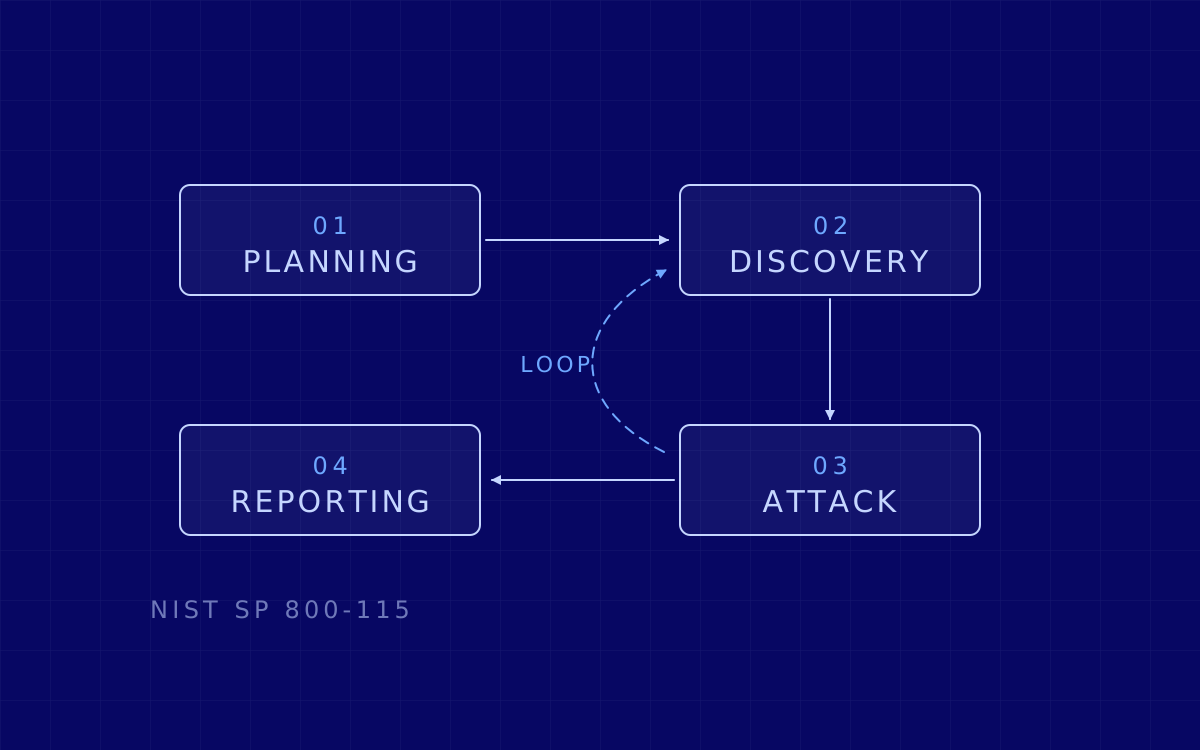
That sequence is not ours. It is the shape of the Penetration Testing Execution Standard, whose seven sections run from pre-engagement interactions to reporting, and of NIST SP 800-115, which groups the same work into Planning, Discovery, Attack and Reporting, with a feedback loop from Attack back into Discovery whenever a foothold opens new ground.
The way in has shifted. The 2026 Verizon Data Breach Investigations Report, covering incidents between 1 November 2024 and 31 October 2025, found that 31% of breaches now start with the exploitation of a software vulnerability, ahead of stolen passwords.
Phase 01. Scope and rules of engagement
Nothing is sent until the scope and the rules of engagement are agreed in writing. The scope names the systems, environments and identities in play. The rules cover the rest: the testing window, the addresses our traffic comes from, how far exploitation may go, and what happens if we find evidence that somebody got there before us.
NIST ships a rules of engagement template as Appendix B of SP 800-115, and the PCI Security Standards Council’s guidance sets out the same questions. In our experience this is the part that goes wrong.
What we need from you before day one
- A network or architecture diagram of what is in scope, and a list of what is out.
- Test credentials for every role that matters, issued to us and revocable by you.
- Confirmation of which environment we test, and whether it is production.
- Interface documentation or API collections. Without them, as PCI’s guidance notes, a tester cannot tell intended behaviour from a flaw.
- Written authorisation from any third party hosting part of the scope.
- A named technical contact who can answer questions the same day.
We also agree success criteria, the point at which the test is finished. PCI’s guidance is direct: defining them sets the depth of the test, and without them a tester can run past the boundaries you expected.
Phase 02. Reconnaissance
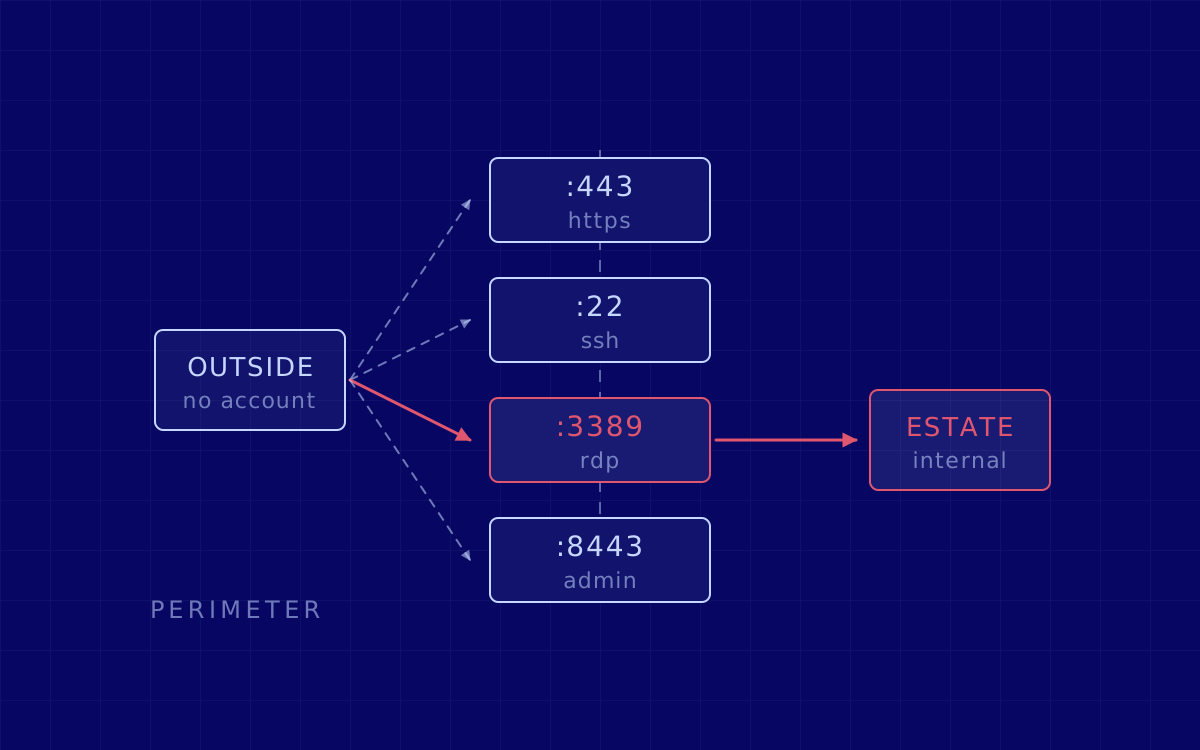
Reconnaissance is the first phase in which anything is sent. We build the picture an attacker builds before choosing a door: hosts and addresses, exposed services and ports, technology fingerprints, endpoints and parameters, identities and the boundaries between roles. NIST puts this first inside its discovery phase, ahead of any vulnerability analysis, and its techniques are still in daily use, from DNS interrogation to banner grabbing.
On external work this is where the surprises live: the host nobody owns, the staging copy that answers to the internet, the subdomain pointing at a service switched off two years ago. We map what we find against your own asset inventory, because the difference between those two lists is a finding in itself.
Phase 03. Threat modelling, and the part that changes with the target
Between recon and testing we stop and do the arithmetic: which attack scenarios are realistic here, ranked by likelihood and by cost. Threat modelling is a phase of its own in PTES because it stops an engagement spending its hours on a generic checklist while the thing that would hurt goes untested.
It is also where the methodology stops being generic. The checklist comes from the standard that governs the target:
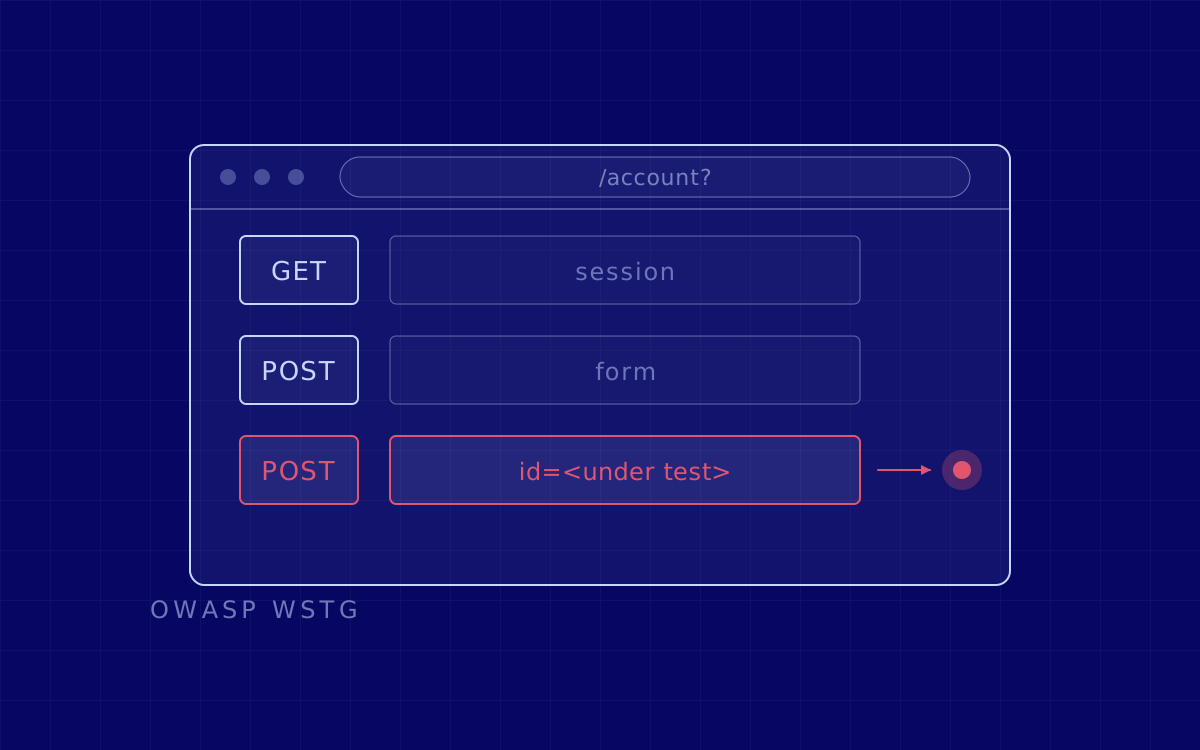
- Web application testing follows the OWASP Web Security Testing Guide, stable release 4.2, whose twelve categories run from information gathering through business logic and client-side testing to API testing, with the OWASP Top 10:2025 as the reporting vocabulary.
- API testing works through the OWASP API Security Top 10, 2023 edition, where three of the top five entries are authorisation failures.
- Mobile testing follows OWASP MASVS and its companion guide MASTG, across storage, cryptography, authentication, network, platform, code, resilience and privacy.
- AI and LLM testing uses the OWASP Top 10 for LLM Applications, 2025 edition, where prompt injection, excessive agency and system prompt leakage are defined.
- Cloud, internal, external, wireless and IoT engagements run on the technique catalogue in NIST SP 800-115 and the platform baseline that applies. One has a walkthrough of its own: how a wireless pentest works.
Phase 04. Vulnerability analysis
Tooling gives coverage. People give truth. Scanners run first because they are fast across a large surface; every candidate is then validated by hand. NIST puts the limit plainly: a vulnerability scanner checks only for the possible existence of a vulnerability, while the attack phase exploits it to confirm that it exists.
The findings that matter most are usually the ones no scanner has a signature for. A business logic flaw. An authorisation check applied on one endpoint and forgotten on the next. A workflow that can be replayed out of order, or completed without the step that takes the payment.
Phases 05 and 06. Exploitation and post-exploitation
Exploitation is verification, not theatre. NIST’s attack phase exists to confirm a suspected weakness by exploiting it, and the loop back into discovery is part of the model: a successful exploit exposes new surface, analysed and tested in turn. That loop is how single findings become chains: a path traversal that only reads files stops being low severity the moment one of those files holds a credential.
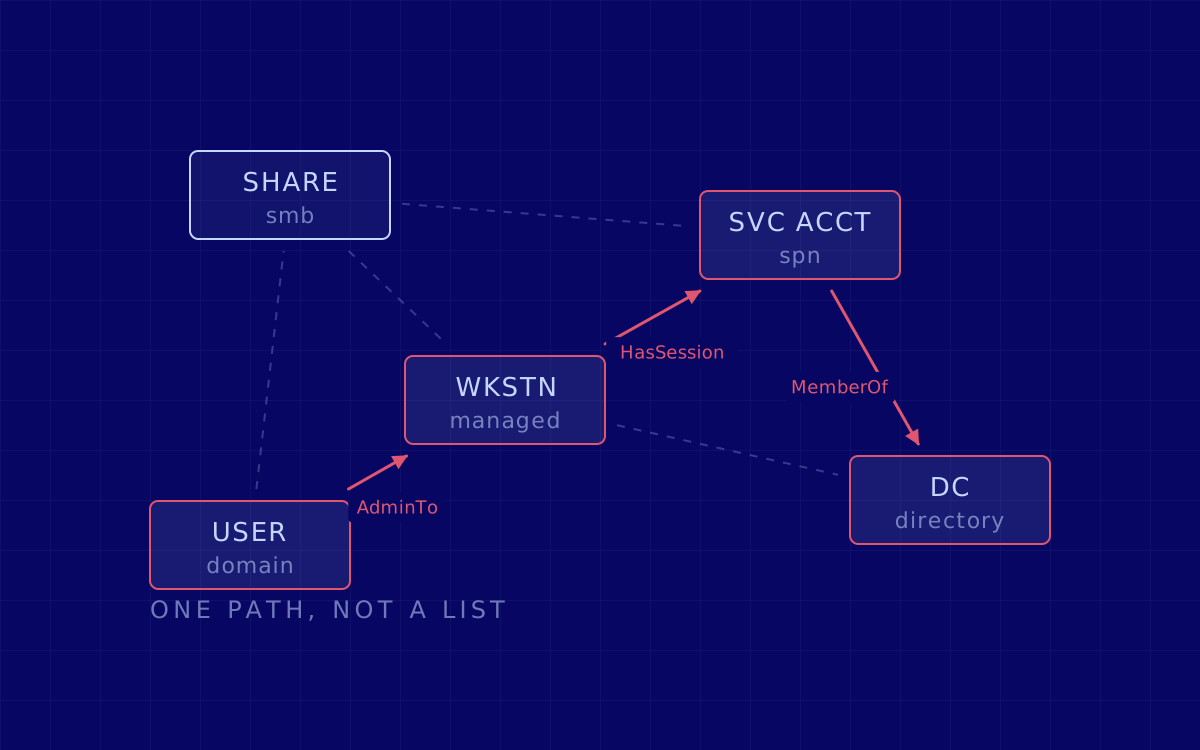
Post-exploitation answers the question your board will ask: so what? We measure the reach of a foothold against confidentiality, integrity and availability, following privilege escalation and lateral movement paths as far as the rules of engagement allow, and no further.
Two rules bind this phase
We take proof, not data: enough evidence to establish impact, never a bulk extraction. And we clean up: accounts created for the test, tools installed and settings changed are documented and reversed, which PCI’s guidance treats as part of the deliverable.
How we rank what you fix first
A severity score is not a work queue. The CVSS v4.0 specification says so itself: consumers are expected to use CVSS as an input to a vulnerability management process that also weighs factors CVSS does not model. So findings are ranked on three signals, not one.
- Severity. CVSS v4.0 base metrics, adjusted with the environmental metrics that describe your deployment.
- Likelihood. EPSS, which estimates the probability that a published CVE will be exploited in the wild in the next 30 days.
- Evidence that it is already happening. If the CVE sits in CISA’s Known Exploited Vulnerabilities catalogue, the argument about likelihood is over. The catalogue listed 1,655 entries in its release of 27 July 2026.
Over those three sits the signal we cannot compute for you: what the affected system is worth. A medium on the service that moves your money outranks a high on the host that serves marketing images.
Phase 07. The report, the walkthrough and the retest
The report is the product. Ours follows the structure the PCI Security Standards Council sets out, because it is legible to an assessor, an auditor and a CTO at once:
- An executive summary: scope and major findings, in language a board can act on.
- A statement of scope and of limitations: what was tested, what was not, and what constrained the work.
- A statement of methodology, and the tools used.
- A testing narrative: how the engagement progressed, including what got in the way.
- The findings, each with a severity, the affected targets, CVE and CWE references, and reproduction steps your engineers can replay.
- Clean-up instructions, so you can confirm the environment is back as it was.
Those findings also land in our platform, where each carries its proof of concept and its business impact, and where fix verification is tracked.
Then the retest. Once you have remediated, we test the fix and either sign the finding closed or say why it is not. PCI’s guidance is precise: remediation should be completed and retested within a reasonable period after the original report, and if it stretches out, a fresh engagement is the honest answer, because the environment has moved.
What sets the length of an engagement
Length is decided by scoping, not by a standard menu, so we will not put a number on your engagement in a blog post. What we can tell you is what moves it, because these are the questions we ask before we agree days with anyone.
- How many distinct user roles exist. Authorisation testing is combinatorial: every extra role multiplies the pairs that have to be tried against each other, and that is where the findings worth having tend to live.
- How much surface recon actually turns up. An external perimeter is scoped against the hosts that answer, not the hosts on the inventory, and those two lists rarely match.
- How complex the authorisation model and the business workflow are. Multi-tenancy, approval chains and payment steps each add paths that have to be walked in the wrong order on purpose.
- Whether we test production or a staging copy. A replica lowers the blast radius and lowers the fidelity with it, and the safety rails production needs cost time of their own.
- How ready you are on day one. Credentials that arrive late do not shorten the engagement, they shorten the testing inside it.
Two things are worth settling before you compare one quote with another. Days quoted for testing are not calendar days: report writing, your review and the retest all sit after the last request is sent.
And depth is bounded by the success criteria the rules of engagement name, which is why PCI’s guidance treats defining them as what sets the depth of the test and keeps a tester inside the boundaries you expected. NIST says the same from the other side: a test often carries a narrow scope because of resource limitations, particularly time, while an attacker takes whatever time they need.
What a penetration test does not cover
What a test does not cover decides whether you are buying the right thing, so it belongs in the same document as the methodology rather than in a conversation afterwards.
- It is not a complete picture of your security. NIST states it directly: testing does not provide a comprehensive evaluation of the security posture of an organisation, and often has a narrow scope because of resource limitations, particularly time.
- It does not test what you excluded. Out of scope means untested, not safe.
- It is a snapshot. An assessment reflects security at a given point in time, as NIST puts it, so your next deployment can reopen what you closed. A pentest supports vulnerability management, it does not replace it.
- It is not a red team exercise. A pentest measures how much of an agreed surface is exploitable, with your team informed. A red team measures, covertly, whether your detection and response work.
- It is not a load test. NIST is clear that direct interaction with a live system risks unexpected halts and denial of service, so we exclude techniques known to cause them.
- It is not a compliance certificate. A clean report satisfies a control inside a framework; it does not make you compliant with the framework. Where a regulation is the driver, the scope must be built for it from the start.
- It does not fix anything. We prove, rank and explain; the change is yours, and the retest confirms you made it.