What you are actually buying
A web application penetration test is authorised, time-boxed and mostly manual work against a running application, by people trying to use it in ways you did not design. Automated tooling appears in one phase, for coverage; it is not where the findings that change a roadmap come from.
Verizon’s 2026 Data Breach Investigations Report, built on more than 22,000 confirmed breaches across 145 countries, reports that exploitation of vulnerabilities is now the most common initial access vector for breaches, at 31%, with credential abuse down to 13%. The dominant class of web bug has not moved: in the OWASP Top 10:2025, Broken Access Control holds first place, and the project states that 100% of the applications in its contributed dataset had some form of broken access control.
Scope of this article
The seven phases of a single
web application pentest, and what each assumes you have ready. Other engagement types run the same seven and differ mainly in phases 3 and 4.
Phase 1: scope and rules of engagement
Nothing is touched until the boundary is written down. Scope names the domains and hosts in play, the environment, the roles to be tested and, just as importantly, what is out: shared SaaS you do not own, payment processors, anything whose provider has not authorised testing.
That boundary lives in the rules of engagement. NIST SP 800-115 publishes a template for it in Appendix B: purpose, scope, assumptions and limitations, risks, and named contacts on each side. It also fixes the testing window, any denial-of-service exclusion, and how test traffic is marked so a real incident is never mistaken for it.
What you need ready before day one
- Credentials for every role, and two accounts per role. Without a second account you cannot test whether user A can reach user B’s data.
- Tester addresses allowed through the WAF and rate limiting, or a documented decision to test through them.
- An environment matching production, with data you are willing to see modified.
- API documentation, or an OpenAPI file, if the front end talks to one.
- A named technical contact who can answer "is this supposed to happen?" the same day.
OWASP’s testing guide advises that the client should "walk the tester through the application ... before the actual test begins".
Phase 2: reconnaissance
NIST SP 800-115 calls this the discovery phase and splits it in two: information gathering and scanning, then vulnerability analysis. On a web application that means inventorying what is exposed before choosing what to attack. Enumerate hosts and subdomains, fingerprint the server and framework, read the metafiles and the old files nobody removed, and map execution paths as each role in turn.
Automated scanning belongs here and nowhere else. It is good at breadth: known component versions, missing headers, default paths, public CVEs in third-party code. It is useless at everything in the next section. What comes out is an inventory of endpoints, parameters, roles and state transitions. It is not a deliverable.
Phases 3 and 4: threat modelling and the web-specific testing
This is where a web test stops looking like every other engagement. Threat modelling ranks attack scenarios by likelihood and business impact; vulnerability analysis works through them against the twelve categories of the OWASP Web Security Testing Guide, stable release 4.2.
Authentication and session handling
Registration, login, password reset, lockout, multi-factor enrolment and recovery, session issue and expiry, and the channels that quietly bypass all of it. Reset flows carry more logic than login and get less scrutiny. Timing counts too: a check that holds one request at a time can fail under two, so login and single sign-on flows are exercised concurrently, not only in sequence.
Authorisation
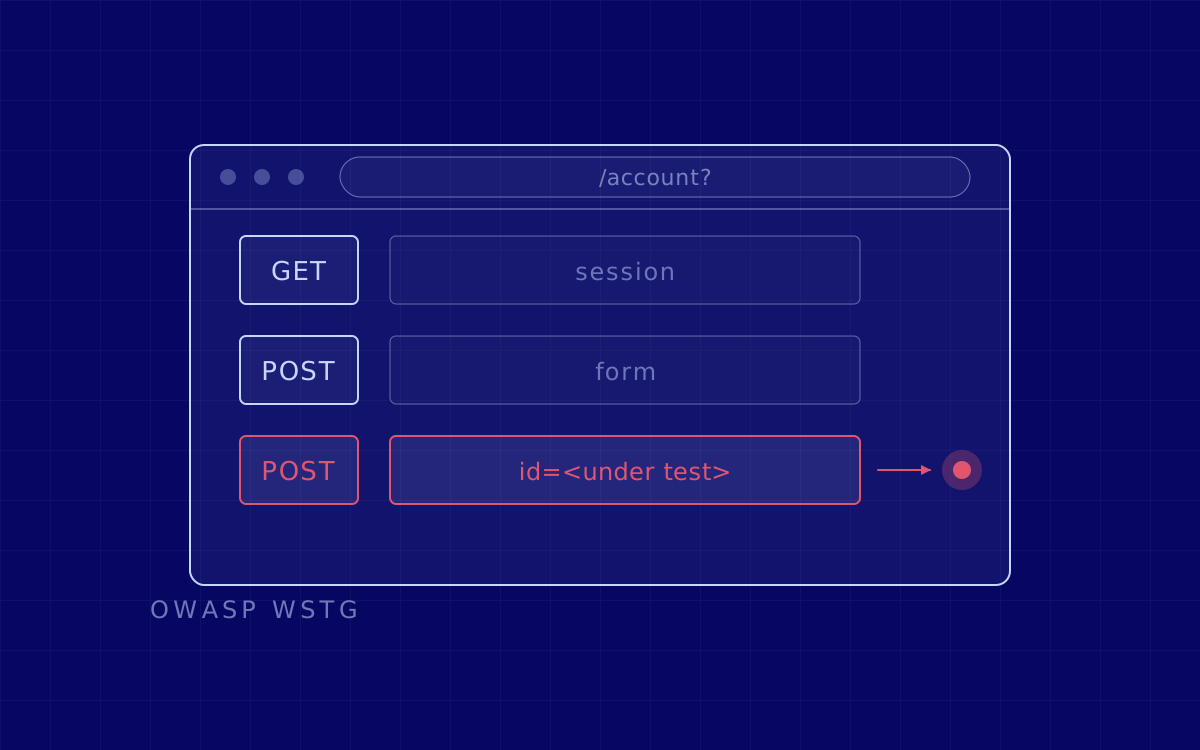
Where most of the value sits. Every object identifier is manipulated from a lower-privileged session to see whether the server enforces ownership rather than the interface merely hiding the link, which is what an insecure direct object reference is. Every privileged function is called directly. In a multi-tenant application the matrix repeats across tenants.
Input handling
Every parameter reaching a parser, a query, a template, a path or an outbound request: SQL injection, cross-site scripting, template injection, deserialisation, path traversal. OWASP notes that injection carries the greatest number of CVEs across the 38 weakness types under it.
Business logic
Steps skipped, prices altered after the summary page, quantities set negative, workflows replayed. A business logic flaw, in OWASP’s words, "cannot be detected by a vulnerability scanner and relies upon the skills and creativity of the penetration tester".
Phases 5 and 6: exploitation and post-exploitation
A candidate is not a finding until it has been proved. NIST puts it plainly: "While vulnerability scanners check only for the possible existence of a vulnerability, the attack phase of a penetration test exploits the vulnerability to confirm its existence."
Two things happen here that no scan can do. The first is chaining: NIST observes that most tests look for "combinations of vulnerabilities ... that can be used to gain more access than could be achieved through a single vulnerability", which is how a low-severity leak plus a forgotten endpoint becomes a compromise: a path traversal reads a configuration file, and the file holds a credential. The second is the loop back into discovery. A server-side request forgery often stops being a web finding the moment it reaches cloud metadata, and continues as a cloud engagement.
Post-exploitation measures impact instead of asserting it: what data could be read, changed or removed, and whose. Each proved finding leaves a proof of concept your engineers can replay. Restraint is part of the method: NIST notes a test "can be designed to stop when the tester reaches a point when an additional action will cause damage", so the proof stops at the last safe step.
Phase 7: the report, and what lands in your inbox
Reporting is not the last week of the engagement. NIST describes it as running alongside the other phases, with logs kept throughout and periodic reports to management. Anything critical is reported the day it is confirmed, not saved for the document.
What you receive
- An executive summary for the people who will not read the technical section: what was tested, what was found, what it means.
- One entry per finding, with affected endpoints, the exact request and response, reproduction steps, evidence and a specific fix. Not "sanitise your inputs".
- A severity per finding. CVSS gives a comparable baseline; what drives your sprint is that score adjusted for what the affected data and function are worth to you.
- A coverage statement: which categories were tested, which were unreachable within scope, and why.
- An attestation letter you can hand to a customer or an auditor without releasing the full report.
The retest, and why it is not optional
Once the fixes land, a retest re-runs the original tests against the original findings and records each as closed, partially fixed or still open. Partially fixed appears more often than anyone expects: the reported payload stops working and a variant of it does not. Report and attestation are reissued against the retested state.
The industry data shows what skipping this costs. The 2026 DBIR found that only 26% of critical vulnerabilities, defined there as those in the CISA Known Exploited Vulnerabilities catalogue, were fully remediated by organisations during 2025, down from 38% the year before, while the median time to full resolution rose to 43 days from 32.
How long it takes, and what changes that
For a single web application, plan on one to two weeks of active testing, preceded by roughly a week for scope, paperwork and access, and followed by reporting. The retest is shorter and comes weeks later. Those are planning ranges: the introductory meeting turns them into dates.
What moves the number is not the page count. It is:
- Roles multiplied by workflows. Two roles and one checkout flow is a small test. Six roles, an admin console and a customer hierarchy is not.
- Whether an API sits behind the front end, and whether it is in scope.
- Multi-tenancy, which adds a cross-tenant authorisation matrix to the per-role one.
- Custom authentication. A standard identity provider is quick to verify; a bespoke session mechanism is not.
- How long access takes to arrive. The commonest cause of a late start is credentials that do not work on day one.
What a web application pentest does not cover
- It is not continuous. NIST is explicit that an assessment "provides a snapshot of security at a given point in time" and "does not provide a comprehensive evaluation of the security posture of an organization": its scope is bounded by time, an attacker’s is not.
- It is not a code review. A test reaches what the running application exposes. Paths behind a feature flag belong to static analysis.
- It is not an infrastructure or cloud test. The account it runs in, the pipeline that deploys it and the cluster hosting it are a cloud pentest.
- It is not an API test by default. If the API is a product surface of its own, it is scoped as an API pentest against the OWASP API Security Top 10.
- It is not a red team. No phishing of your staff, no physical entry, no evasion of your detection.
- It is not a certificate. OWASP’s methodology page cites PCI DSS Requirement 11.3 as a standard that defines penetration testing. A test produces evidence a standard asks for; producing it is not certification.
The honest limit
No test of finite length proves an application is secure. It proves that a named team, within a stated scope and number of days, found these things and not others. A report claiming more is selling something else.
The standards behind the seven phases
- PTES defines seven sections: Pre-engagement Interactions, Intelligence Gathering, Threat Modeling, Vulnerability Analysis, Exploitation, Post Exploitation and Reporting. That is the shape of the seven phases above.
- NIST SP 800-115 groups the same work into four phases, planning, discovery, attack and reporting, with reporting running across the other three and a loop from attack back to discovery.
- OWASP WSTG, stable release 4.2, supplies the content: twelve categories of web application tests, from information gathering to API testing. A checklist, not a script.
- OWASP Top 10:2025 and OWASP ASVS 5.0.0, released on 30 May 2025, give the risk vocabulary and the verification requirements findings are written against.
- CISA KEV sets priority: a component in scope carrying a CVE in that catalogue goes to the top whatever its base score. It listed 1,655 entries in its release of 27 July 2026.
If an auditor asks which methodology your test followed, the answer should be a document they can open. The web application pentesting service page lists what we test and what we need from you.