What a cloud pentest actually proves
A cloud penetration test answers one question: which single exposure in your AWS, Azure or Google Cloud estate actually reaches your data or your control plane. Not how many misconfigurations you have. Which of them connect.
That distinction is the whole job. A cloud security posture management (CSPM) tool returns hundreds of findings against a benchmark and cannot tell you which three of them chain. A pentest is a person following the chain by hand: this bucket is public, it holds this key, that key assumes this role, that role reads this database.
The threat data points the same way. The Cloud Security Alliance’s Top Threats to Cloud Computing 2024 ranks misconfiguration and inadequate change control first, identity and access management second, and insecure interfaces and APIs third. All three are things you configure, not things your provider runs.
The short version
A posture tool tells you what is wrong. A pentest tells you what is reachable, and proves it.
Before anything is touched: scope, access and rules
Nothing is enumerated until the paperwork is done. Almost every argument later in an engagement traces back to something not written down here.
What you need ready
- The accounts, subscriptions or projects in scope, and their regions.
- A read only role in each, and a technical contact who can answer the same day.
- An architecture overview: which environments are production, where the regulated data sits, what the trust between them is supposed to be.
- Written authorisation from whoever owns the estate, including anything running on infrastructure you do not control.
The rules of engagement
The rules of engagement record what may be touched and what may not: which accounts, whether production data may be listed or read, whether resources may be created, and who gets called if something breaks. Read only enumeration first, controlled exploitation only inside those rules.
Your provider’s policy sits on top of yours, and the three do not agree.
- AWS. Permits testing of a listed set of services without prior approval. Prohibits denial of service, traffic flooding, DNS zone walking via Route 53 and S3 bucket takeover. Needs two weeks’ notice for simulated events such as red team exercises with command and control, or malware testing.
- Microsoft. Allows fuzzing, port scanning and vulnerability assessment against your own Azure virtual machines inside your own tenant. Prohibits denial of service testing.
- Google. Does not require you to contact it before testing your own Cloud Platform infrastructure, provided you abide by the Acceptable Use Policy and Terms of Service and affect only your own projects.
Reconnaissance, with no credentials at all
Testing starts where a real attacker starts: from the public internet, with no account and no key.
- Public storage. Buckets and containers that list or serve objects, including those whose names are guessable from your naming convention.
- DNS and certificate transparency. Subdomains pointing at cloud endpoints, including ones nobody remembers creating, and dangling records pointing at deleted resources.
- Public compute and interfaces. Exposed management ports, API gateways, load balancers, container registries and open consoles.
- Code and build systems. Public repositories, published image layers and build logs. This is where a long lived access key most often leaves the building.
Nothing is acted on yet. This is intelligence gathering in PTES terms, the first half of discovery in NIST SP 800-115 terms.
The phase that only exists in cloud: mapping identity
On a web test the interesting object is a request. On a cloud test it is an identity. This phase has no equivalent in the other pentest types, and it takes the most time.
With the read only role we enumerate the estate as it is, not as the diagram describes it: roles and their trust policies, permission boundaries and service control policies, key and storage policies, and every machine identity attached to a workload. That list is then cut down to what is reachable from where we stand.
The routes that pay off most often
- Secrets outside the secret store. Repository history, pipeline variables, image layers, instance user data and build artefacts.
- The metadata service. A server side request forgery that reaches the instance metadata service hands over the role credentials of the machine. AWS documents that an instance accepts either IMDSv1 or IMDSv2 by default, and that IMDSv2 needs a PUT request to open a session and refuses a token to any caller sending an X-Forwarded-For header.
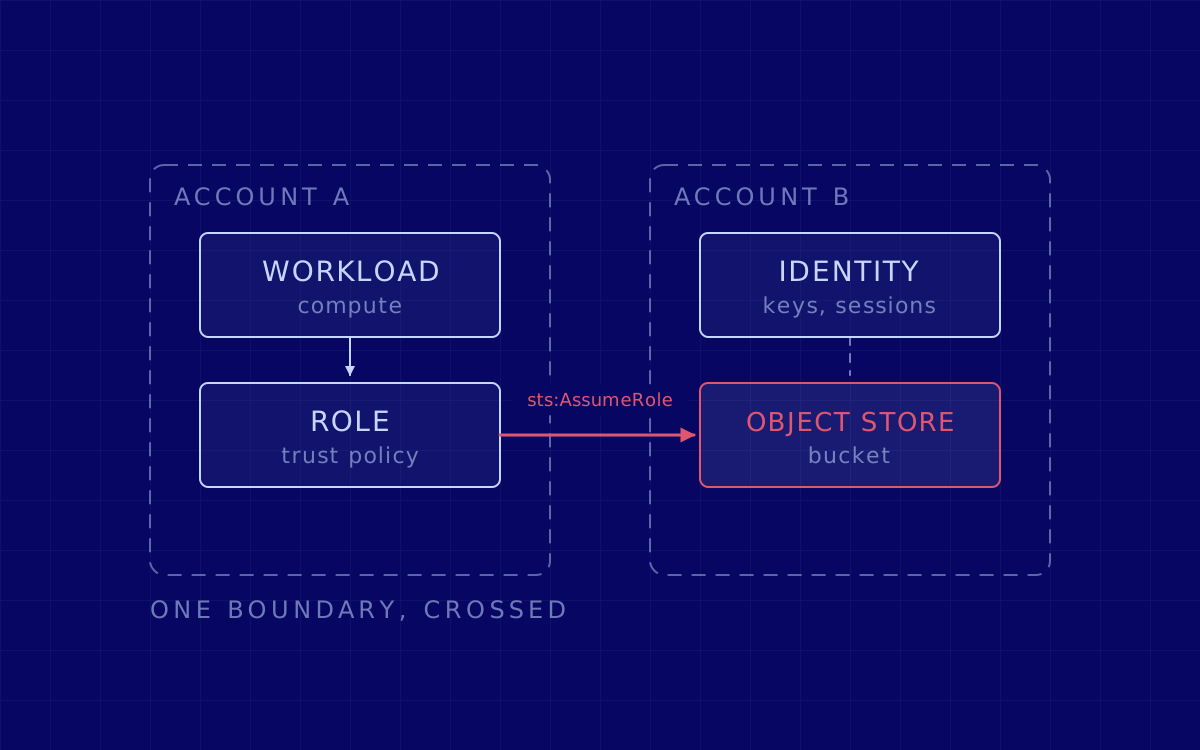
- Trust wider than the diagram. A role whose trust policy accepts more principals than the team believes is how cross account trust stops being a boundary and becomes a hop.
- Cluster permissions. Kubernetes RBAC bindings granting a service account more of the cluster than its workload needs, and the node role underneath the pod.
None of this is quick to fix. Verizon’s 2026 Data Breach Investigations Report, which draws on more than 22,000 confirmed breaches, looks separately at how third party cloud exposure gets remediated: only 23% of those organisations fully remediated missing or improperly secured multi factor authentication on their cloud accounts, and for weak passwords and permission misconfigurations it took almost eight months to resolve half of all findings.
Exploitation and verification: proving the chain
Everything so far is a hypothesis. This phase turns each into a proof, or discards it.
We attempt the escalation: a limited role turned into a bigger one through a policy it can attach or a pipeline it can trigger. Then the hop into the next account, and the reach into the data: object storage, database snapshots, the keys that decrypt them. Every attempt runs inside the rules agreed on day one, and every successful one is captured as the exact request, the policy that permitted it, the response and a timestamp.
Privilege escalation has to be demonstrated rather than inferred: "this role could theoretically escalate" is a finding your engineers will argue with; "this role escalated at 14:12, here is the call" is one they will fix. And a chain is taken far enough to establish what it reaches, no further.
Patchable vulnerabilities belong here but are rarely the headline. The same Verizon report puts exploitation of vulnerabilities at 31% of known initial access vectors, ahead of credential abuse at 13%, and finds that only 26% of critical vulnerabilities, defined as those in CISA’s Known Exploited Vulnerabilities catalogue, were fully remediated during 2025, down from 38% the year before. That catalogue held 1,655 entries on 27 July 2026; anything appearing on it is tested first.
A chain like this, told end to end, reads like this: a server-side request forgery in a public application reaches the metadata service, the instance role credentials allow a second role to be assumed, and an over-permissive bucket policy turns that second role into reading another tenant’s data. Three configurations that were nothing on their own.
What you get, and in what form
The report is the only part of the engagement most of your organisation will read, so it addresses two audiences.
- An executive summary stating, in business terms, what one exposure reaches and how far.
- The proven chains with reproducible steps: request, policy, response, evidence and the specific remediation, ranked by business impact rather than scanner severity.
- Findings delivered live in our platform as they are found, not only at the end.
- A retest report and an execution certificate for the audit folder.
The frameworks behind it
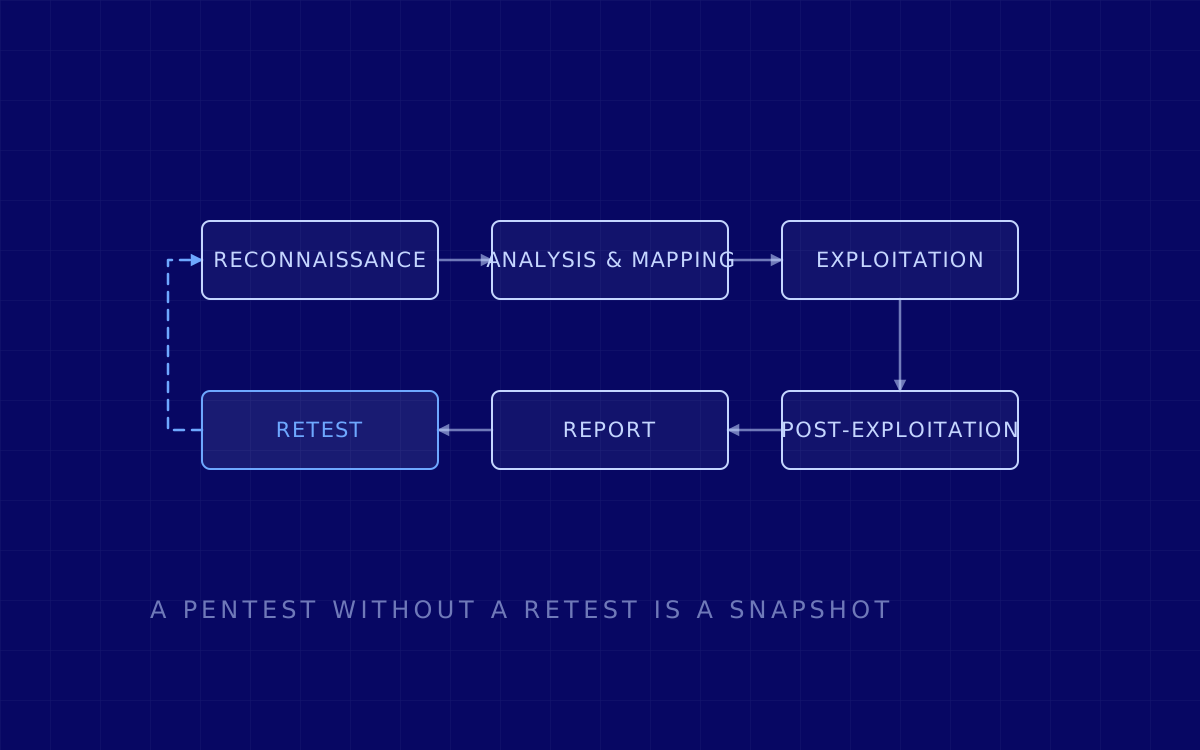
NIST SP 800-115 describes a four stage methodology of planning, discovery, attack and reporting, with a feedback loop from attack back to discovery whenever an exploit reveals something new. That is what following a cloud chain looks like. PTES sets out seven sections: pre engagement interactions, intelligence gathering, threat modelling, vulnerability analysis, exploitation, post exploitation and reporting.
Findings are mapped onto MITRE ATT&CK, whose cloud matrix covers IaaS, SaaS, identity provider and office suite platforms, and onto the relevant CIS Benchmark. CIS publishes Foundations Benchmarks for AWS, Azure and Google Cloud, plus benchmarks for managed Kubernetes including EKS and GKE.
How long it takes, and what moves the range
A single account or subscription on one provider is typically one to two weeks of active testing. A multi account, multi region or multi cloud estate, or one with significant Kubernetes, is typically two to four weeks. Scoping happens before that window and the retest after your fixes.
- How many accounts there are, and how much trust runs between them: ten that share nothing are faster than three that share everything.
- Whether Kubernetes and serverless are in scope. Each adds an identity model on top of the provider’s own.
- Whether you provide a read only role. Testing purely from outside mirrors a real attacker but covers far less ground in the same time.
- How much of the estate is managed as code. An account described by its Terraform is faster to map than one built by hand.
- Whether it is production, which means tighter rules and narrower windows.
The range is fixed in the proposal, not extended mid engagement because something interesting turned up.
What a cloud pentest does not cover
This is the section most providers leave out, and the one that prevents an argument in month three.
- Your provider’s own infrastructure. Under the shared responsibility model, AWS protects the infrastructure that runs its services; you are responsible for the guest operating system and its patches, your application software, and how you configure the controls AWS provides. We test your side of that line.
- Availability. Denial of service and load testing are out by default, and both AWS and Microsoft prohibit them.
- Continuous coverage. A pentest is a point in time. It does not replace posture management, image scanning or patching; it tells you which of their findings matter now.
- Full application security. Where an application runs in the estate we test it far enough to reach the cloud, usually through a request forgery or a file handler. Testing it properly is a web or API engagement of its own, measured against the OWASP Web Security Testing Guide and the OWASP API Security Top 10, where request forgery is API7:2023 and security misconfiguration is API8:2023. See how a web application pentest works and how an API pentest works.
- Source code. Unless you commission a review, we work from the role you provide, not from your repository.
- Your people. Phishing and pretexting are a separate exercise, and on AWS a simulated event that has to be authorised first.
The retest, and what closed actually means
A finding is not closed because a ticket moved column. It is closed when the original proof stops working.
The retest replays each proven chain against the fixed environment, using the steps recorded in the report. It fails at the step you changed, and closes with dated evidence. Or it still works, and you get the new request that proves it. Or it fails at a different step, which usually means the symptom was patched and the cause was not. That last outcome is why a retest starts from the original proof, not from the recommendation.
For an ISO 27001, ENS, PCI DSS or SOC 2 file, the retest evidence is what the auditor wants: not that you had findings, but that you closed them and can show the before and after, with timestamps.
The same seven phases applied across every engagement type are set out in our pentesting methodology, end to end. The scope and deliverables for this one are on our cloud pentesting page.
Sources
Every figure and framework reference above comes from one of these.