Offensive security, absolute clarity
Expert-led penetration testing, red team and dark web monitoring, every finding proven by hand and tracked live in our platform until it is fixed and re-verified.
Not a scanner dressed up as a service. Not a PDF that dies in an inbox. Security that measurably improves, with a free retest on every fix.




















The attack landscape is shifting.
Attackers are getting in faster, and more often, through weaknesses that were already known. Exploiting unpatched vulnerabilities is now among the leading ways breaches begin (Verizon DBIR 2026). Offensive cybersecurity is how you find those weaknesses before they do.
What reduces your real exposure is closing the gap between what an attacker finds first and what your team fixes first. We help you close it in three places.
Source: Verizon 2026 Data Breach Investigations Report, figure 5, "Known initial access vectors in non-Error, non-Misuse breaches over time" (n for the 2026 dataset = 19,905). The 2026 percentages are the report’s own; earlier years are read from that figure and are accurate to about a point.
See your real attack surface
Most teams do not have a complete picture of what they expose: forgotten subdomains, old cloud assets, third-party connections. We reveal it the way an attacker would discover it, so you stop guessing and start protecting what is actually reachable.
Get findings that are real, and ranked by what they cost you
A scanner produces hundreds of alerts and no judgement. We hand you a short list of weaknesses we have actually exploited, each one explained in plain business terms, so your team knows which fix protects revenue or data and which is cosmetic.
Prove the fix worked
A finding is not closed until it is verified. Our platform tracks every fix as your developers work, and our free retest confirms it against the original proof. Your security posture actually moves, and you have the evidence to show it.
Penetration testing and offensive cybersecurity services.
Our work falls into three areas: penetration testing (across web, APIs, cloud, AI, internal and external systems), red team, and dark web monitoring. You get findings that are clear, proven and ranked, ready to act on from day one.
Web, mobile and API pentesting
We test the applications your customers and revenue depend on, by hand, finding the logic and access-control flaws automated tools miss. Every finding comes with proof and a fix path.
Red Team
We act like a real, determined attacker targeting your business, end to end, to measure how far we get, how fast your team notices, and how well your defences hold.
Cloud pentesting
We look at your AWS, Azure or GCP the way an attacker would, finding the misconfigured permissions and exposed services that quietly open a path to your data.
AI pentesting
We stress-test the AI features your team has shipped, from prompt manipulation to data leakage, and prove what happens when someone tries to turn your own assistant against you.
Internal pentesting
We start where a phished laptop or a stolen password would put an attacker, already inside, and prove how far they could reach across your network and systems.
Dark Web Monitoring
We watch the forums, marketplaces and leak sites where stolen data ends up, and alert you the moment your credentials or documents appear, before they are used against you.
From finding to fixing.
A PDF gets filed and the fixes stall. Here every finding lives with its proof, its business impact and its fix, until a free retest closes it.
Server-side code injection vulnerabilities arise when an application incorporates user-controllable data into a string that is dynamically evaluated by a code interpreter. If the user data is not strictly validated, an attacker can use crafted input to modify the code to be executed, and inject arbitrary code that will be executed by the server.
Server-side code injection vulnerabilities are usually very serious and lead to complete compromise of the application’s data and functionality, and often of the server that is hosting the application.
The injected expression is evaluated by the export service, which runs as root, so an unauthenticated attacker can:
- Read and modify every file and database the service can reach, including report data and any credentials held in its configuration.
- Run arbitrary commands on the host and use it to reach internal systems that are not exposed to the internet.
- Alter or delete the evidence trail, since logs and exports are written by the same compromised process.
Payload injected into the report_name parameter is concatenated into a dynamically-evaluated Python expression. Sending the request below returns uid=0(root) in the response body.
POST /api/v2/reports/export HTTP/1.1
Host: api.acme.example
Content-Type: application/json

{
  "format": "csv",
  "report_name": "q1'+__import__('os').popen('id').read()+'"
}
Findings you can see, as we find them
Results appear in the platform in real time, with proof and a clear fix path, so your team can start before the engagement even ends.
A workspace that stays open
Your access does not close when the test does. Findings, retests and audit evidence live in one place, engagement after engagement.
Every fix re-verified, free
Mark a finding fixed and we test it again against the original proof, at no extra cost. The loop actually closes.
Excellence across sectors.
Every sector faces the same question in its own language: what would a real attacker do to us?
We answer it with the regulatory fluency each one needs.
Animation: a sample bank account panel goes from the account holder view to that of someone who gets in without authorisation, with the identifiers uncovered and the transfer control available.
Fintech
We protect your customers’ funds, their trust, and your standing under DORA and PCI DSS.
See how we help FintechAnimation: two sample customers kept apart on one platform; an API request changes its identifier, crosses the isolation boundary and returns the other customer data.
Tech and SaaS
We protect the customer confidence and security proof that gate your next enterprise deal and funding round.
See how we help Tech and SaaSAnimation: a sample patient record goes from the clinician view to unauthorised access, with diagnosis, medication and history reachable from the internet.
Health
We protect patient data and clinical continuity under HDS, EHDS and GDPR oversight.
See how we help HealthAnimation: a sample plant control interface goes from operator mode to control by an outsider, who takes the parameters off setpoint, closes a valve while the pump is running and disarms the emergency stop.
Energy and Industrial
We protect operational continuity and resilience under NIS2 and the CER Directive.
See how we help Energy and IndustrialNot every pentest is the same.
A pentest can be anything from an automated scan to an attack done by hand. This is what actually changes the outcome, and where we sit.

Every claim in the Asperis column is something you can hold us to in writing. The column opposite describes common market practice, not any particular firm.
How we run every engagement.
A seven-phase method, aligned with the recognised standards your auditors know, adapted to your scope and delivered live in our platform.
Pre-engagement Interactions
We agree the scope, the rules and the safety limits in writing. Clear objectives, no surprises.
Intelligence Gathering
We map your attack surface the way an attacker studies you before deciding where to go in.
Threat Modeling
We turn that map into realistic attack scenarios, ranked by risk and business impact.
Vulnerability Analysis
We separate by hand the vulnerabilities that are genuinely exploitable from the noise an automated scanner leaves behind.
Live in the platformExploitation
We safely demonstrate what matters, chained the way a real attacker would and within the agreed rules.
Post Exploitation
We show what each finding would really cost, with proof your own team can reproduce.
Reporting
Reports for the board and for engineering, a live walkthrough, and a free retest that proves the fix held.
Live in the platformHow we think, what we find.
Original research and a look inside how our team works, so you can judge the substance before you ever talk to us.
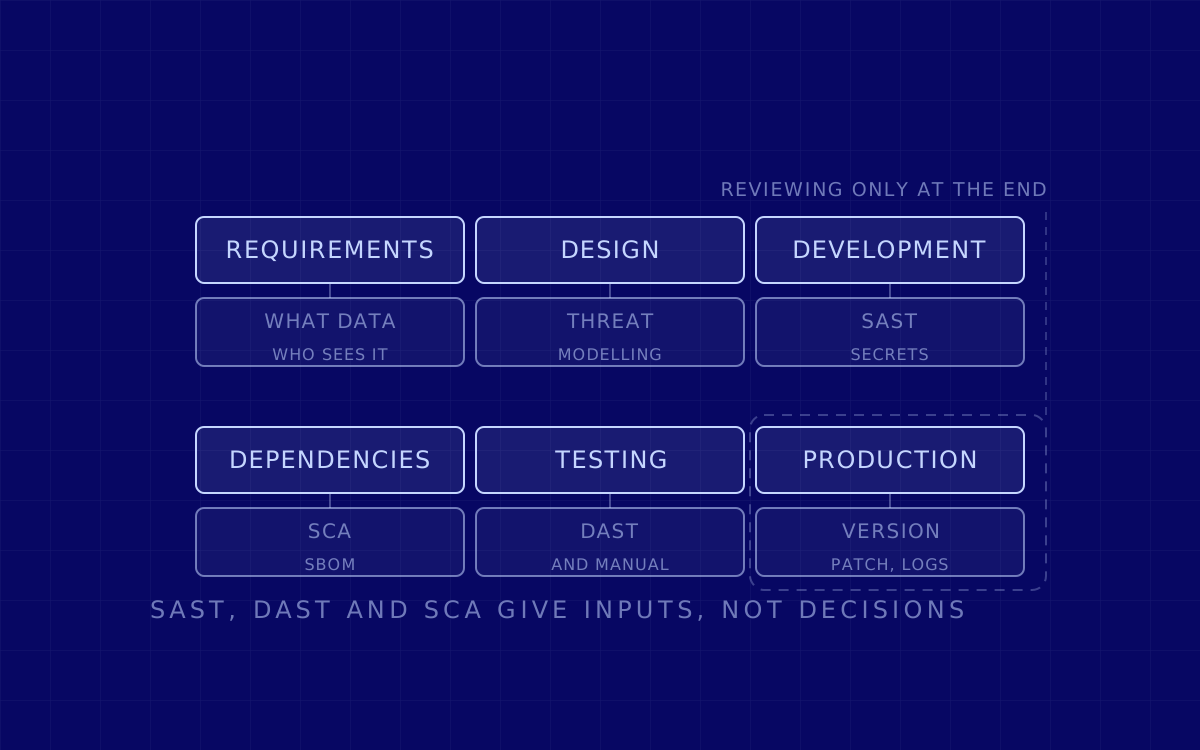 Guides
 Secure development lifecycle (SSDLC): what it is and how to put it in place
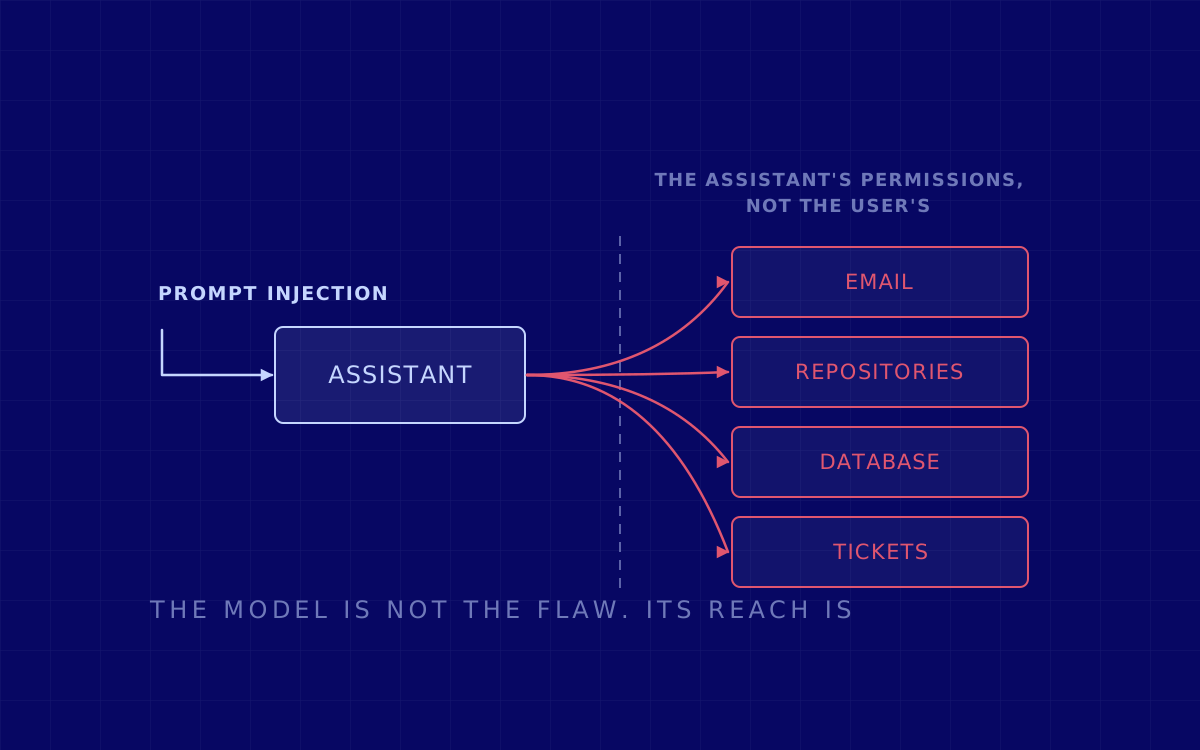 Guides
 Cybersecurity and artificial intelligence: what actually changes
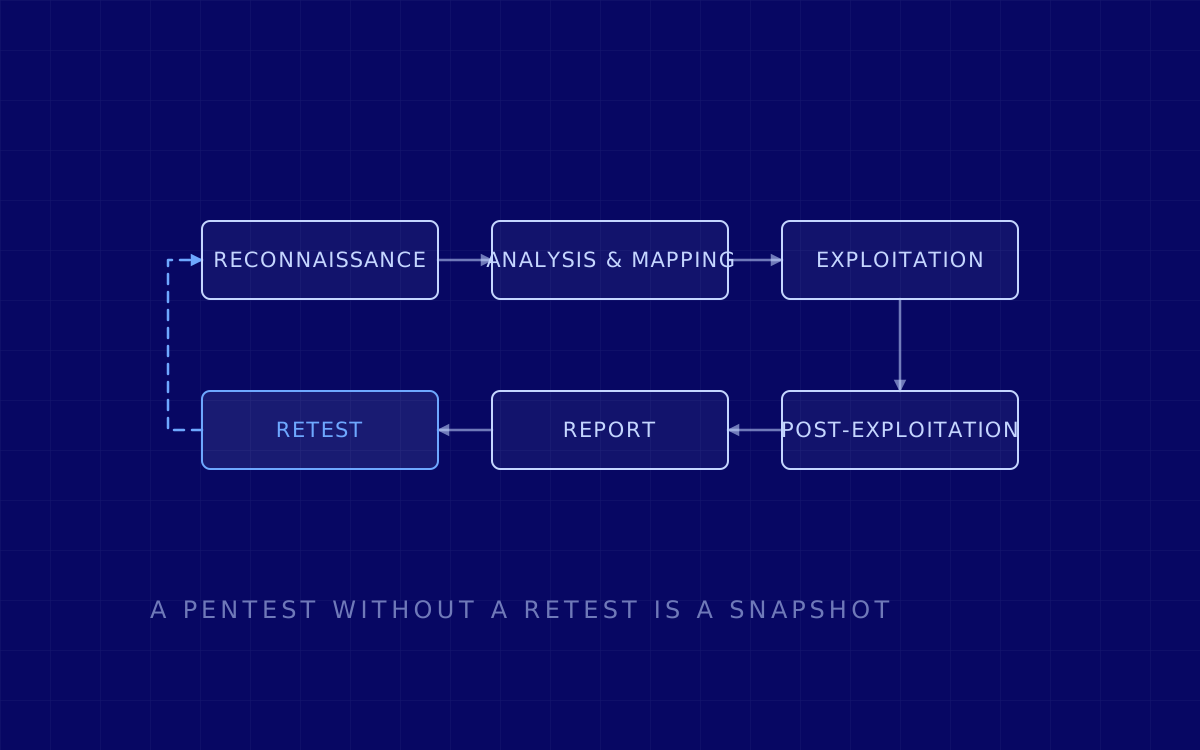 Guides
 What penetration testing is: scope, phases, deliverable and retest
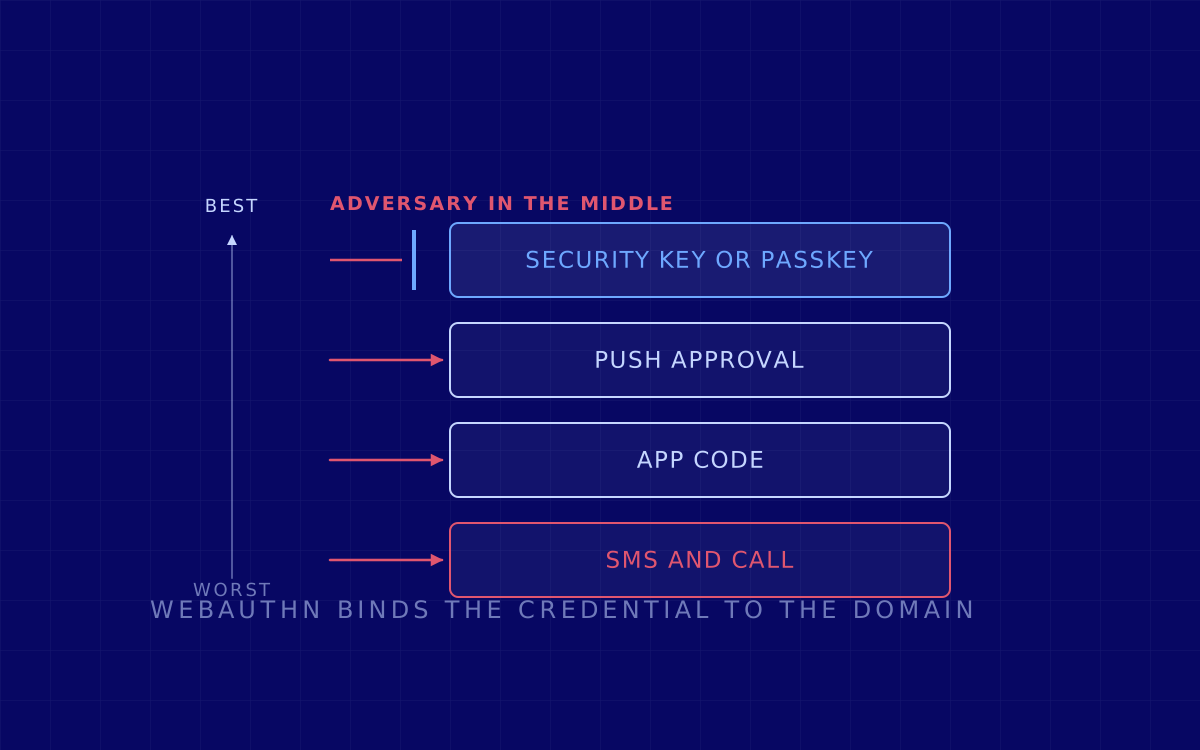 Guides
 Two-factor authentication: how it works and how it gets bypassed
What our clients say.
You can speak to our clients directly. If you would rather hear it from them than from us, ask on your first call and we will make the introduction.
“We at Etnia highly value our collaboration with Asperis Security. Their professionalism, approachability, quick response and ability to adapt to our needs have been key in every project. The quality of service and continuous support always give us peace of mind. Without a doubt, it is a pleasure to have them as technology partners.”
“ASPERIS has worked alongside us to define and implement our cybersecurity roadmap in Microsoft 365 with a structured approach aligned to business objectives. Thanks to their advice, we took the strategic step of completing our Microsoft ecosystem and reinforcing it with CrowdStrike for advanced mobile device protection, significantly raising our security level.”
“At NPAW we have collaborated with Asperis on various security initiatives and the experience has been very positive. We especially value their ability to adapt to our needs and the depth with which they approach each project. Results are clear, structured and useful for decision-making and continuous security improvement. We like working with Asperis for the judgment and value they bring to every collaboration. Their work has helped us strengthen our security level.”
“With Asperis you don’t hire a service. You hire a partner. They don’t look to bill a project. They look to establish a relationship of trust, caring about the key points that affect your organisation’s security. Professionalism, know-how and diligence.”
Frequently asked questions about offensive cybersecurity.
The questions security leaders ask us most often before the first call.
Offensive cybersecurity is the practice of testing your defences the way a real attacker would, instead of assuming they work. It covers penetration testing, red team exercises and dark web monitoring. Rather than a checklist, it gives you proof of which weaknesses are genuinely exploitable, what they would cost, and how to fix them, so your security improves on evidence rather than hope.
A scan is an automated tool that lists possible weaknesses, mostly unverified and full of false positives. A penetration test is a specialist who confirms by hand which of those weaknesses can actually be exploited in your environment, and what the business impact would be. The scan tells you what might be wrong; the pentest proves what is, and what to do about it first.
Automated and AI tools are excellent at breadth: checking many things quickly against known patterns. They miss what real attackers use first: flaws in your specific business logic, chains of small issues that add up, and anything that requires human reasoning. We use tools to accelerate coverage, but every finding is validated, exploited and explained by a person.
Three things. We do offensive security only, so there is no upsell of managed services diluting the work. The senior specialist who scopes your engagement is the one who runs it and re-verifies your fixes, and that is the person you deal with directly. And every engagement runs through our platform, not a PDF, with a free retest included. Our team is NASA Bug Bounty verified and holds OSCP, OSCE³, OSWE, OSEP, CRTO and CRTP certifications.
Three core areas. Penetration testing across web, mobile, APIs, internal and external networks, cloud, AI, IoT, Active Directory and wireless. Red team exercises, including those run within the TIBER-EU framework or the DORA threat-led testing provisions when the competent authority determines it. And dark web monitoring and brand protection. Around those three we also offer phishing simulation, Microsoft 365 hardening and security team training. Everything runs through our platform with a free retest.
Yes. Our testing produces the audit-ready evidence these frameworks require, mapped to recognised methodologies, with an execution certificate and signed retest evidence. For financial entities, that same exercise runs within the TIBER-EU framework or the DORA threat-led testing provisions when the competent authority determines it. We speak the language of both your auditors and your engineers.
You reach a senior specialist who runs engagements, and we reply within one business day. The first call is 30 minutes to understand what you need and agree the scope, and you leave it with a clear next step and, within 48 hours, a fixed-price proposal.
Asperis Security is based in Barcelona and works with clients across Europe. Our platform is hosted in the EU and your data never leaves it, which matters for GDPR and for the sectors we serve most: fintech, technology and SaaS, health, and energy and industrial.
Discover your company’s real exposure level.
Book a 30-minute call with a specialist who knows what to ask. No decks, no sales pitch, just a clear picture of where you stand and a sensible next step.
- A senior specialist replies within one business day
- Proposal after the first meeting, tailored to your needs
- Dark web analysis with no commitment before the meeting
Protected by reCAPTCHA. The Google Privacy Policy and Terms of Service apply.
Thanks. We got your details.
A specialist will email you within one business day to arrange the introductory meeting.
Could not send. Please try again or email us.
Or email [email protected].