What Hack The Box is
Hack The Box (HTB) is a hacking lab platform that puts vulnerable machines in front of you and asks you to compromise them with no guidance. There is no brief walking you through it: you get an IP address, and the goal is to get in, escalate privileges and prove it by capturing the flags the machine hides.
Two more things sit around those labs. An academy with theory modules you study and get examined on, for anyone who needs the foundation before the practice. And a community that publishes its solutions once a machine retires, which is where the real learning happens: comparing your route with six other people’s is the closest thing to peer review this discipline has.
Plans are split between individual use, companies that want to train their team, and universities. There is a free tier you can start on without paying anything.
What TryHackMe is
TryHackMe (THM) organises learning the other way round. Its unit is not the standalone machine but the room: a controlled environment with one specific lesson behind it, with an explanation, an exercise and questions that get validated as you go. Rooms chain into learning paths that take you from level zero to specific specialisms.
Almost everything runs from the browser, so you do not have to build an attack machine before you start, and that is one entry barrier fewer among the ones that usually knock people out in the first week. The gamification (points, badges, visible progress) is there on purpose: it sustains consistency, which is the real problem with any training plan.
It also has a free tier, individual plans, and plans for organisations and education.
Where they actually differ
Both have labs, both have paths and both have a free version, so comparing catalogues settles nothing. The difference that matters is one of method.
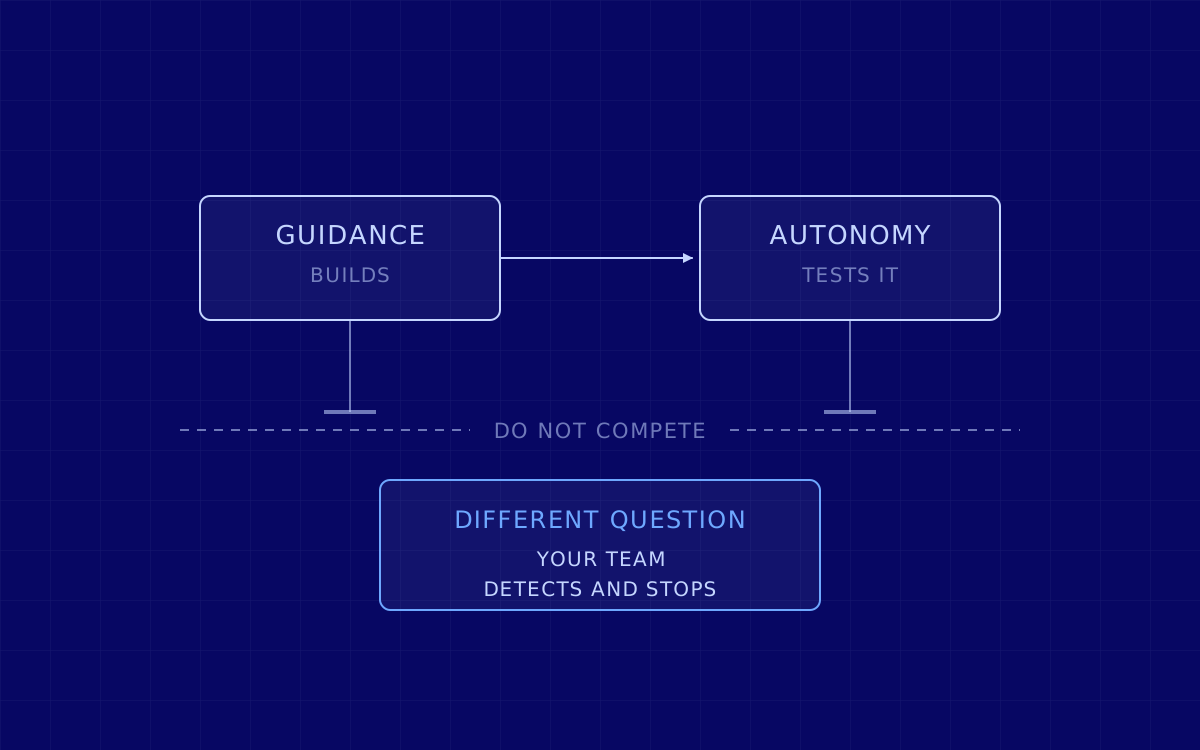
- Guidance against autonomy. THM tells you what you are trying to learn and checks that you learned it. HTB gives you an objective and says nothing else. The first teaches faster; the second teaches you not to freeze, which is half the job.
- Path against catalogue. On THM the order is given to you. On HTB you build the order yourself, and picking the wrong next machine is a common way to lose weeks.
- Entry curve. THM is built so that somebody with no technical base gets somewhere on day one. HTB assumes things (networking, Linux, the command line) that you will not deduce from the brief if you do not have them, because there is no brief.
- How real the environment feels. The more advanced HTB scenarios look more like what you meet on a real penetration test: long chains, dead ends and noise. That is exactly what makes it hard and what makes it useful.
- What progress measures. On THM progress is the percentage of the path. On HTB progress is how many machines you have solved. Those are two different things, and the second one says nothing about whether you understood what you did.
Which one to pick
If you are starting out, TryHackMe. Lowering the entry barrier matters more than it looks when the thing being decided is whether you are still going in month three or gave up in month one.
If you already have a base and what you want is fluency solving things unaided, Hack The Box. It is also the better preparation for the hands-on certifications, the ones that sit you in front of an environment and ask for results rather than multiple-choice answers.
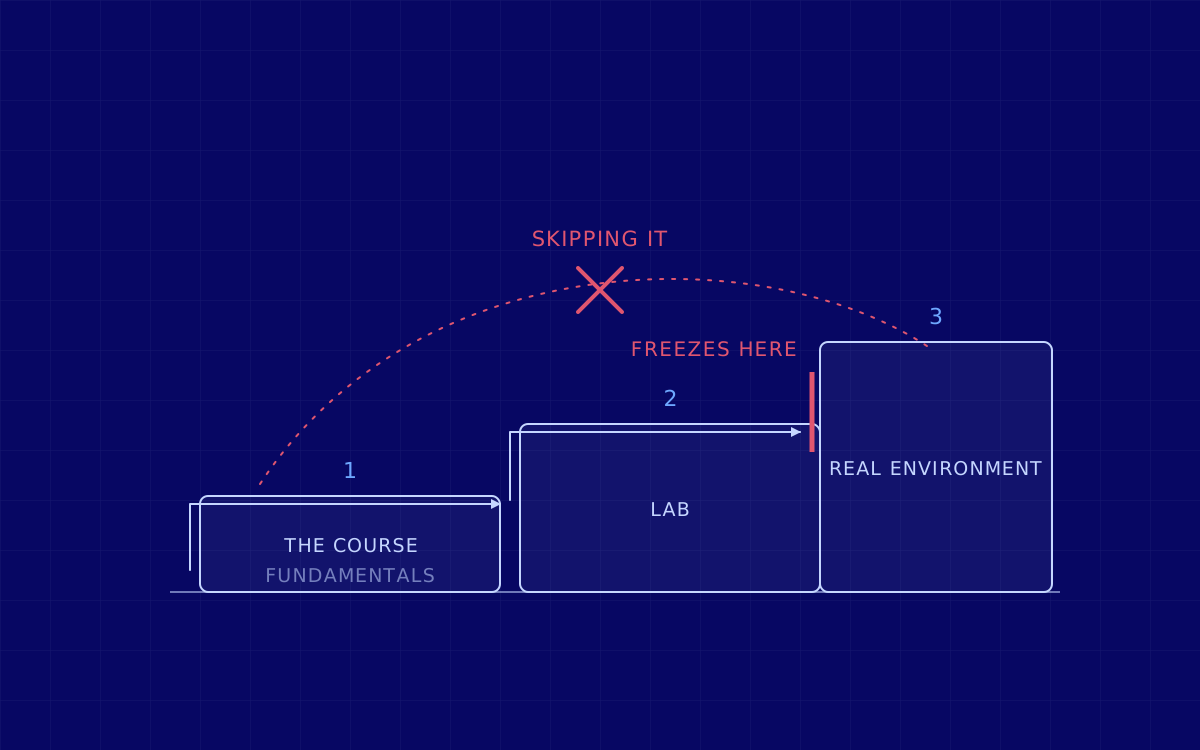
And the honest answer is that plenty of people use both, because they do not compete: one builds the foundation and the other puts it to the test. If the budget only stretches to one, start with the guided one and move across when the rooms start feeling small.
If you are choosing for a team, not for yourself
Almost everything written about these two platforms is aimed at one person who wants to learn. Choosing for a team is a different question, and it has three differences that appear in no feature comparison.
- Being able to assign, and being able to see. A team is not served by everyone picking on their own: you need to assign paths by role and to see who has moved and who has not. That lives in the business plans and not in the individual one, and it is the first thing to look at.
- Scenarios that look like yours. A generic lab teaches technique. It does not teach your Active Directory, your cloud or your application, which is where you are going to be attacked. The further the lab sits from your stack, the more translation your people have to do on their own.
- A platform does not answer the question you have. Labs measure whether one person can solve a challenge. They do not measure whether your team detects and stops what would happen to you. There are other exercises for that: adversary emulation, the red team and, when the point is that attack and defence learn at the same time, the purple team.
We run training for company teams on that second half: on your stack and on the threats that actually apply to you. It does not replace a lab, and we are not saying that out of modesty: to pick up base technique, one of these two platforms is cheaper and better than we are. What they do not give you is the part that depends on your own house.
And if the question in front of you is not what to train but who to hire, that is a different conversation: you have it in how to choose a cybersecurity company in Spain.
A note on this comparison
This piece compares two products that are not ours, and whose catalogues, plans and free tiers change without telling us. That is why you will find no user counts, no lab counts and no prices here: any number we wrote today would go stale without anyone noticing, and we would rather describe how each one works, which is the part that does not change. Check their official pages before you decide.
Last reviewed: 3 August 2026. Originally published on 11 January 2024.